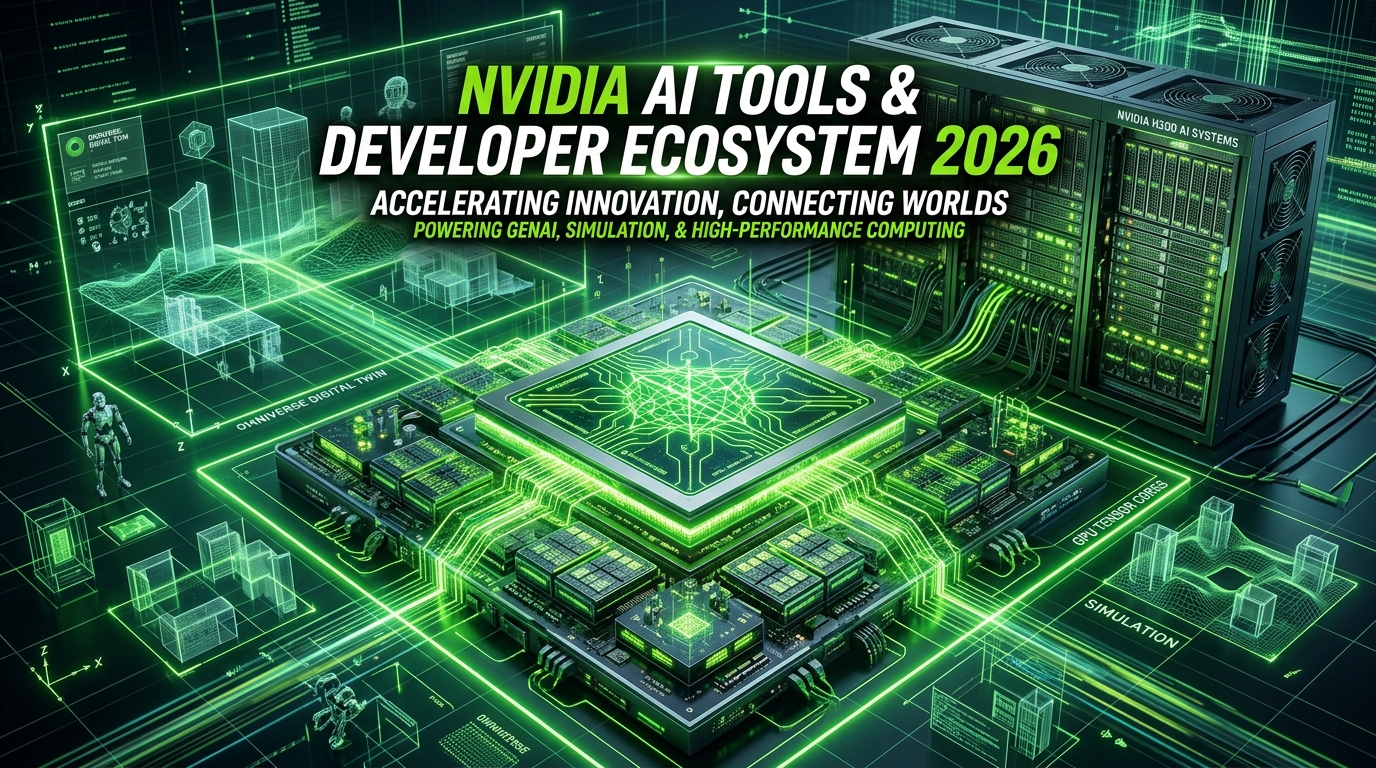
NVIDIA powers the foundation of global artificial intelligence, offering enterprise developers optimized microservices, model alignment frameworks, and inference acceleration via NVIDIA NIM, NeMo, TensorRT-LLM, and Omniverse.
Quick Facts & 10-Tool Comparison Matrix
| Tool / Framework | Primary Purpose | Supported Hardware | Verified 2026 Pricing | Free / Open Source? | Performance Acceleration | Rating |
|---|---|---|---|---|---|---|
| NVIDIA NIM | Containerized AI Microservices | NVIDIA GPUs (Cloud / On-Prem) | Free Developer / $4,500/GPU/yr (Enterprise) | Yes (Free Dev Tier via API) | 2x – 4x higher throughput vs stock vLLM | 9.9/10 |
| TensorRT-LLM | LLM Inference Optimization Engine | Ampere, Ada, Hopper, Blackwell | 100% Free Open Source | Yes (GitHub Open Source) | In-flight batching, FP8 & FP4 quantization | 9.9/10 |
| NVIDIA NeMo | End-to-End LLM Training & Guardrails | Multi-Node GPU Clusters | Open Source Core / AI Enterprise | Yes (Apache 2.0 Core) | Distributed Megatron training & safety rails | 9.7/10 |
| NVIDIA Omniverse | Physical AI & Digital Twins | RTX & Enterprise GPUs | Free Individual / Enterprise tiers | Yes (Individual license) | Real-time OpenUSD physics simulation | 9.8/10 |
| NVIDIA DeepStream | Multi-Stream Video AI Analytics | Jetson Edge & Data Center GPUs | 100% Free SDK | Yes | Zero-copy vision inference across 64+ cameras | 9.6/10 |
| NVIDIA AI Workbench | Local-to-Cloud Hybrid Dev Environment | RTX PCs & Cloud Instances | 100% Free Desktop App | Yes | Effortless project migration between desktop & cloud | 9.5/10 |
| Ollama | Local LLM Runner (Uses CUDA) | Consumer GPUs & CPUs | 100% Free Open Source | Yes | Instant one-command CLI model deployment | 9.8/10 |
| vLLM | Open Community Inference Engine | NVIDIA GPUs & AMD ROCm | 100% Free Open Source | Yes | PagedAttention memory management | 9.7/10 |
| Triton Inference Server | Multi-Framework Production Serving | CPUs, GPUs & TPUs | 100% Free Open Source | Yes | Concurrent model execution across PyTorch & ONNX | 9.6/10 |
| NVIDIA Isaac Sim | Robotics Simulation & Synthetic Data | RTX GPUs & Omniverse | Included with Omniverse | Yes | Trains physical robots in photorealistic physics | 9.8/10 |
What is This Topic?
While NVIDIA is globally famous for manufacturing modern GPU hardware (such as the H100, H200, and Blackwell B200 accelerators), the true moat safeguarding its trillion-dollar valuation is its comprehensive CUDA Software and AI Tooling Ecosystem.
In 2026, building production artificial intelligence requires more than raw silicon. Developers must optimize memory bandwidth, quantize 70-billion-parameter models into 4-bit precision, orchestrate distributed training across thousands of nodes, and enforce corporate data governance. NVIDIA has unified these capabilities into modular software suites spanning generative text, computer vision, robotics simulation, and enterprise microservices.
Main Answer: The Four Pillars of NVIDIA AI Software
1. NVIDIA NIM (Inference Microservices)
NVIDIA NIMs are pre-built, containerized microservices that package frontier models (such as Llama 3.3, DeepSeek-R1, Mistral, and Nemotron) with pre-compiled TensorRT-LLM acceleration engines into standard Docker containers. Developers deploy a NIM on their local workstation, private Kubernetes cluster, or cloud instance with a single command, immediately exposing OpenAI-compatible REST API endpoints.
2. TensorRT-LLM: The Speed Standard
TensorRT-LLM compiles neural network computation graphs directly to GPU hardware kernels. By implementing In-Flight Batching (which continuously adds new requests to active GPU execution queues without waiting for entire batches to finish) and FP8/FP4 quantization, TensorRT-LLM quadruples token throughput while halving memory footprint.
3. NVIDIA NeMo Framework
NeMo is NVIDIA's comprehensive enterprise framework for building, customizing, and aligning custom large language models. It provides:
- NeMo Megatron: Parallelized distributed training across thousands of GPUs.
- NeMo Guardrails: Programmatic boundaries that prevent models from engaging in off-topic discussions, leaking private credentials, or executing unsafe code.
- NeMo Aligner: Scalable Reinforcement Learning from Human/AI Feedback (RLHF/RLAIF).
4. NVIDIA Omniverse & Physical AI
For physical AI and embodied robotics (such as humanoid bipeds and autonomous factory robots), Omniverse provides physics-accurate virtual simulation based on Pixar's Universal Scene Description (OpenUSD). Robots learn navigation, grasping, and obstacle avoidance in simulation before deploying to physical hardware.
Tools, Products & Practical Code Implementation
Example: Running a Self-Hosted Llama 3.3 NIM Microservice
Developers can pull and run a local NVIDIA NIM container with a single command:
```bash
Run local Llama 3.3 70B NIM with TensorRT-LLM acceleration
docker run -d --gpus all -e NGC_API_KEY="YOUR_NVIDIA_API_KEY" -p 8000:8000 nvcr.io/nim/meta/llama-3.3-70b-instruct:latest
`
The microservice exposes standard endpoints:
```bash
curl -X POST "http://localhost:8000/v1/chat/completions" -H "Content-Type: application/json" -d '{
"model": "meta/llama-3.3-70b-instruct",
"messages": [{"role": "user", "content": "Explain quantum annealing in 2 sentences."}]
}'
`
How NVIDIA AI Tools Differ from Generic Open-Source Stacks
- Bare-Metal Silicon Kernel Tuning: Unlike generic PyTorch models that run unoptimized CUDA kernels, TensorRT-LLM fuses multi-head attention operations into handwritten GPU assembly, extracting 95%+ of maximum theoretical hardware throughput.
- Turnkey Enterprise Security: NVIDIA AI Enterprise containers undergo continuous vulnerability scanning, come with guaranteed CVE patches, and meet strict enterprise SOC2 standards.
- OpenAI API Drop-In Compatibility: Every NVIDIA NIM speaks the universal OpenAI
/v1/chat/completionsprotocol, allowing businesses to switch from OpenAI to private local GPUs with zero code changes. - Physical World Simulation: No other AI company possesses a platform comparable to Omniverse for simulating photorealistic physical laws and robotic sensor feeds.
Verified 2026 Pricing & Licensing
| Tier / Offering | Official Price | Inclusions | Target Audience |
|---|---|---|---|
| NVIDIA Developer Program | 100% Free | 1,000 free API credits on build.nvidia.com, SDK downloads | Individual engineers & students |
| TensorRT-LLM & NeMo Core | 100% Free Open Source | Apache 2.0 license on GitHub | Researchers and developers |
| NVIDIA AI Enterprise (NVAIE) | $4,500 / GPU / year | 24/7 enterprise support, validated NIMs, CVE indemnification | Fortune 500 enterprises |
| NVIDIA Omniverse Individual | Free Download | Single-user RTX workstation license | 3D designers and technical artists |
| NVIDIA Omniverse Enterprise | $9,000 / year (Pack) | Multi-user collaboration, Nucleus server | Industrial simulation and robotics labs |
Best Use Cases Breakdown
| Use Case | Best NVIDIA Tool | Performance Benefit | Hardware Fit |
|---|---|---|---|
| High-Throughput Enterprise API Serving | NVIDIA NIM | 3.5x token throughput increase | A100, H100, H200 Cloud / On-Prem |
| Autonomous Robot Training | Omniverse Isaac Sim | 10,000 hours of simulated flight in minutes | RTX 4090 to DGX Station |
| Regulated Local Offline LLMs | TensorRT-LLM + NeMo Guardrails | 100% air-gapped data privacy | Dual RTX 4090 or single A6000 |
| Smart City Video Analytics | NVIDIA DeepStream | Real-time object tracking across 64 camera feeds | NVIDIA Jetson AGX Orin |
| Domain-Specific LLM Fine-Tuning | NeMo Framework | Distributed LoRA and full fine-tuning | Multi-GPU cloud instances |
Operational Limitations & Constraints
- Hardware Vendor Lock-In: NVIDIA AI developer tools are strictly engineered for NVIDIA hardware and cannot accelerate AMD ROCm or Apple Silicon GPUs.
- VRAM Footprint Requirements: Running large models (such as 70B parameter models) requires minimum 48GB to 80GB of GPU VRAM, requiring professional enterprise cards or dual consumer GPUs.
- Steep CUDA Learning Curve: Optimizing custom TensorRT kernels and configuring multi-node InfiniBand interconnects requires specialized systems engineering expertise.
- Enterprise Licensing Costs: While developer tiers are free, production deployment under NVIDIA AI Enterprise carries substantial per-GPU annual fees.
Who Should Use NVIDIA AI Tools?
- Enterprise Machine Learning Engineers: Teams deploying scalable, secure LLMs inside private virtual clouds or on-premise data centers.
- Autonomous Robotics Engineers: Researchers training humanoid robots, quadrupeds, and drones within physical simulations.
- Computer Vision Engineers: Developers building real-time video surveillance, defect detection, and retail analytics pipelines.
- Local AI Enthusiasts: Developers running private high-speed local inference on RTX workstations using CUDA and TensorRT acceleration.
Frequently Asked Questions (FAQ)
What are NVIDIA NIMs and how do they work?
NVIDIA NIMs (Inference Microservices) are containerized packages that bundle open-source and proprietary models with optimized TensorRT-LLM runtime engines into standardized Docker containers exposing OpenAI-compatible APIs.
Are NVIDIA AI tools free to use?
Yes. The open-source frameworks (TensorRT-LLM, NeMo, Triton) and developer API tiers on build.nvidia.com are completely free. Production deployments requiring official enterprise support use the NVIDIA AI Enterprise license.
What is TensorRT-LLM?
TensorRT-LLM is an open-source library that optimizes large language model inference on NVIDIA GPUs using in-flight batching, kernel fusion, and FP8 quantization to maximize token generation speed.
Can I run NVIDIA NIM microservices on consumer RTX graphics cards?
Yes. Supported desktop NIMs can run on workstations equipped with RTX 4080, RTX 4090, or RTX Ada Generation GPUs with adequate VRAM.
How does NVIDIA NeMo help with AI safety?
NeMo Guardrails enables developers to define strict conversational boundaries, preventing models from discussing restricted topics, generating unsafe code, or hallucinating false data.
What is NVIDIA Omniverse?
Omniverse is a platform for building physical AI simulations, industrial digital twins, and robotics training environments using Pixar's OpenUSD standard.
What is the difference between Ollama and TensorRT-LLM?
Ollama prioritizes ease of use and runs on multiple hardware backends (NVIDIA, Apple Silicon, CPU). TensorRT-LLM is built for maximum production throughput exclusively on NVIDIA GPUs.
Can I try NVIDIA models without installing hardware?
Yes. Visit build.nvidia.com to test models (Llama 3.3, Nemotron, DeepSeek-R1) via free cloud API credits directly in your browser.
What programming languages do NVIDIA AI tools support?
The primary languages are Python (for training, orchestration, and API consumption) and C++/CUDA (for low-level kernel optimization and embedded systems).
What is Triton Inference Server?
Triton is an open-source inference serving software that manages concurrent model execution across multiple frameworks (PyTorch, TensorRT, ONNX) on both CPUs and GPUs.
Does NVIDIA offer AI tools for robotics?
Yes. The NVIDIA Isaac robotics platform (including Isaac Sim, Isaac ROS, and Isaac Lab) provides end-to-end simulation and deployment tools for autonomous robots.
Why is CUDA considered NVIDIA's biggest competitive moat?
CUDA has been refined over nearly two decades, with millions of software libraries, algorithms, and frameworks optimized specifically for NVIDIA kernels, making rival hardware migration difficult.
Verified Sources & Documentation
- NVIDIA Developer Official Portal
- NVIDIA NIM Microservices Documentation
- TensorRT-LLM Official GitHub Repository
- NVIDIA NeMo Framework Documentation
Related AI Launch Watch Tools & Reviews
- Best Free Open Source AI Models (2026)
- Best AI Coding Tools and Agents
- Exclusive Gemini AI Pro 18-Month Deal
- AI Tools Directory