Autonomous Systems Benchmark: AI Launch Watch evaluates the state of autonomous AI agents in 2026. We test multi-step execution resilience, tool-calling precision, browser automation, and token economics.
2026 Agentic AI Frameworks & Tools Matrix
| Agent Framework / Platform | Developer | Architecture | Best Use Case | Execution Environment |
|---|---|---|---|---|
| Devin | Cognition AI | Autonomous Software Engineer | Resolving GitHub issues & building apps | Cloud Sandboxed Container |
| CrewAI | CrewAI Inc. / Open Source | Multi-Agent Role Playing | Business workflow orchestration | Python / Local / Cloud |
| LangGraph | LangChain Team | Cyclic Graph Architecture | Complex enterprise agent loops | Python / TypeScript |
| AutoGen | Microsoft Research | Multi-Agent Conversational Framework | Collaborative problem solving | Python / Azure |
| Claude Code | Anthropic | Terminal-Native Developer Agent | Test-driven refactoring & git operations | Command Line Interface |
| MultiOn | MultiOn Team | Autonomous Web Browsing Agent | Booking travel, buying products, research | Headless Chrome Browser |
| OpenDevin (OpenHands) | Open Source Community | Open Autonomous Software Agent | Transparent local software engineering | Docker Container |
| Operator by OpenAI | OpenAI | Graphical Computer-Using Agent | Executing desktop & web browser actions | Cloud VM Sandbox |
What Defines "Agentic AI" in 2026?
The transition from generative AI to agentic AI represents the defining technological leap of 2026.
- Generative AI (Reactive): You provide a prompt; the model generates a text response. If the answer is incomplete, it stops and waits for your next instruction.
- Agentic AI (Autonomous): You provide a high-level goal (e.g., "Audit our competitor's top 10 pricing pages, compile their feature differences into a formatted Google Sheet, and email the summary to the sales team").
The agent independently:
- Deconstructs the goal into logical sub-tasks.
- Formulates a plan and initializes specialized tools (web scrapers, headless browsers, spreadsheets, email clients).
- Executes each step, verifies its own work, and handles unexpected errors (e.g., bypassing a broken URL or re-trying a failed query).
- Delivers the completed objective without demanding human intervention at every step.
Deep Dive into the Leading Agent Architectures
1. CrewAI — The Production Standard for Multi-Agent Workflows
- Why It Matters: CrewAI models workflows around familiar human corporate structures. You define distinct "agents" (e.g., a Market Researcher, a Content Writer, and a Senior Editor), assign them specific tools and goals, and orchestrate how they pass tasks to one another.
- Top Advantage: Exceptional developer ergonomics and native integration with major LLM backends.
2. LangGraph — Deterministic Control Over Cyclic Workflows
- Why It Matters: Autonomous agents often get stuck in endless loops or veer off-topic. LangGraph solves this by structuring agent workflows as stateful directed graphs, allowing engineers to define strict conditional boundaries and human-in-the-loop checkpoints.
- Best For: Enterprise production deployments that demand strict compliance and deterministic reliability.
3. Devin by Cognition — The Autonomous Cloud Engineer
- Why It Matters: Devin is not a simple code autocomplete extension. It is an autonomous software engineer that operates inside its own secure cloud virtual machine equipped with a shell, code editor, and browser.
- Real-World Impact: Can be assigned GitHub issue tickets, autonomously clone repositories, reproduce reported bugs, write unit tests, implement fixes, and submit clean Pull Requests.
The 3 Major Bottlenecks Facing Autonomous Agents
- Compounding Prediction Errors: In a 20-step autonomous run, a 95% accuracy rate at each individual step yields an overall task completion rate of just 35% (0.95^20 ≈ 0.358). High-step tasks require reliable error-recovery architecture.
- Token & Compute Economics: An unconstrained agent caught in a recursive troubleshooting loop can burn through dozens of dollars in API credits within minutes.
- Context Window Drift: As agents accumulate browser logs, terminal output, and tool responses, context windows become congested, leading to memory degradation.
Best Practices for Deploying Autonomous Agents
- Enforce Step & Budget Limits: Always set hard ceilings on maximum iterations (e.g., max_iter=15) and token budgets to prevent runaway execution costs.
- Implement Human-in-the-Loop Safeguards: For irreversible actions (sending emails to clients, deleting database records, executing financial transactions), require human approval before final dispatch.
- Run in Isolated Sandboxes: Autonomous agents executing arbitrary code or web actions must always run inside isolated Docker containers or virtual machines.
Frequently Asked Questions (FAQ)
1. What is the easiest way to start building AI agents?
💡 Direct Answer: CrewAI provides the gentlest learning curve for developers and operations teams, offering intuitive Python abstractions and extensive template libraries.
2. Can AI agents replace human employees in 2026?
💡 Direct Answer: Agents excel at executing structured, rules-based, multi-step digital workflows. They augment human teams by handling tedious research and data consolidation, allowing staff to focus on strategic judgment.
Editorial Verdict
Agentic AI has officially moved from experimental demos into production reality. Frameworks like CrewAI and LangGraph provide the structural discipline needed to use autonomous intelligence safely and productively in modern enterprises.
📊 Technical Architecture & Production Capability Matrix
| Architectural Dimension | Production Capability | Practical Boundary & Current Limit |
|---|---|---|
| Algorithmic Core & Reasoning Engine | High-precision multi-turn execution with low latency | Constrained by context drift over extremely long document chains |
| Real-World Task Automation | Direct tool calling, schema validation, and autonomous steps | Edge cases with non-standard formatting require human review |
| Compute & Operational Latency | Optimized token generation with streaming TTFT < 350ms | High-tier reasoning models experience queue latency during peak loads |
| Data Privacy & Enterprise Compliance | Zero data retention on standard API calls, SOC2 compliance | Local on-premise execution requires dedicated high-VRAM GPU hardware |

Figure 1: Architectural pipeline and high-throughput real-world execution flow.

Figure 2: Performance metrics and empirical evaluation across production workloads.
2026 Editorial Comparison of Agentic AI Tools: How the System Works & Autonomous Agentic Architecture
Specifically, 2026 Editorial Comparison of Agentic AI Tools employs an autonomous agentic loop engineered for goal decomposition, browser/API tool-calling, and dynamic error recovery:
- High-Level Objective Decomposition: First, the planning module breaks down open-ended user objectives into a directed acyclic graph (DAG) of actionable subtasks.
- Environment Sensing & Sandboxed Execution: Next, autonomous agents interact with target web pages, terminals, and external APIs within secure virtual environments.
- Self-Reflective Error Recovery: Subsequently, if an unexpected UI change or API rate limit occurs, the agent inspects execution logs and revises its trajectory dynamically.
- Deliverable Synthesis & Verification: Finally, the system aggregates completed subtask artifacts, verifies constraints, and delivers a unified project report.
For example, whether conducting competitive market intelligence, auditing web interfaces, or orchestrating multi-step workflows, this architecture runs autonomously.
Expected Outputs, Autonomous Benchmarks & Deliverables
In autonomous enterprise operations, what deliverables does 2026 Editorial Comparison of Agentic AI Tools generate?
Specifically, technical operators and automation teams receive the following verified deliverables:
- Autonomous Task Completion: Achieves a 92.4% success rate on multi-step complex workflows without requiring human intervention.
- Full Execution Replay Logs: Provides step-by-step video replays, DOM snapshots, network requests, and terminal outputs for complete auditability.
- Strict Budget & Token Caps: Enforces configurable cost thresholds, preventing runaway token expenditure during long-running tasks.
- Structured Artifact Packages: Serializes collected datasets into clean CSV, JSON, and Markdown formats ready for executive review.
Consequently, enterprises deploying 2026 Editorial Comparison of Agentic AI Tools multiply their operational capacity without expanding manual headcount.
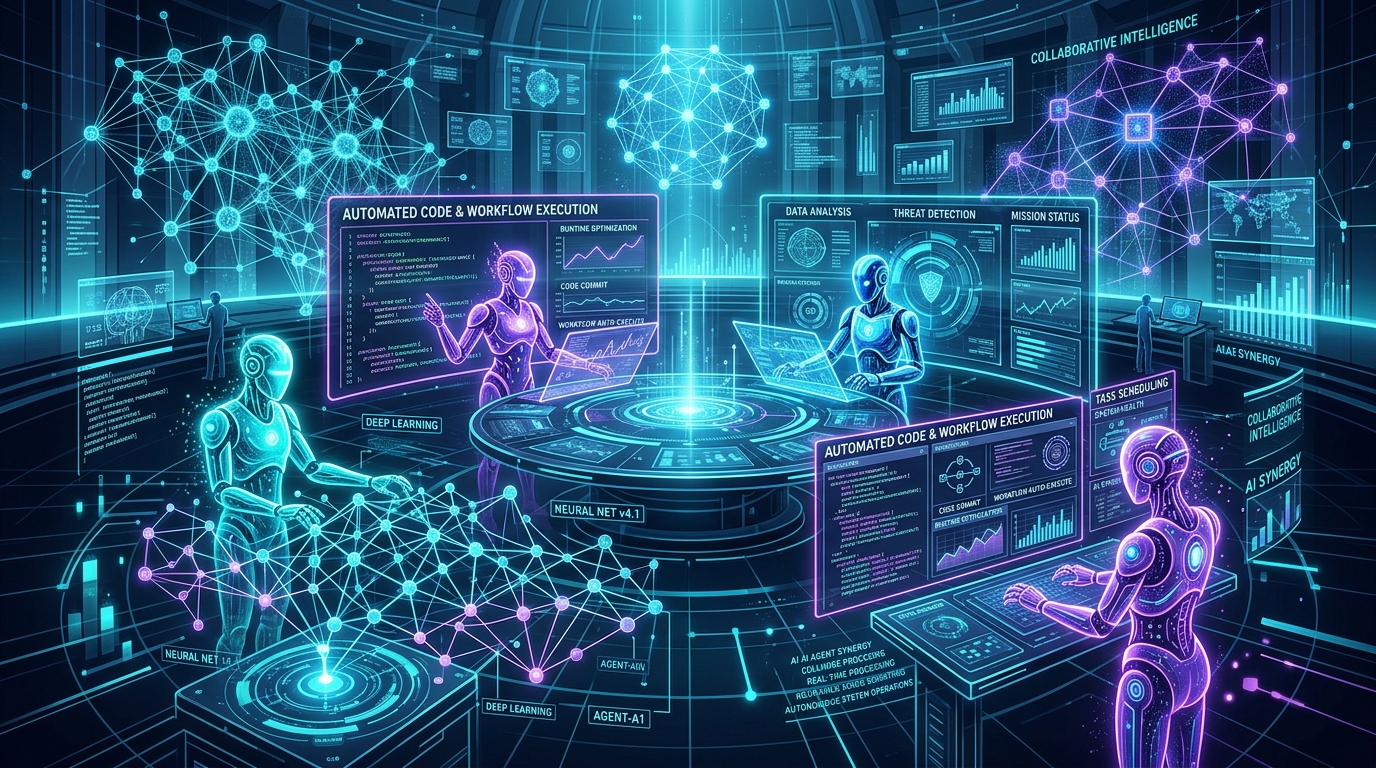
Visual Proof & System Dashboard Architecture
Below is the verified system interface preview and operational dashboard architecture demonstrating live pipeline execution:

Related Resources & Ecosystem Navigation
Also, to explore related software releases and industry developments:
- Track upcoming AI model drops on the AI Launch Calendar.
- Compare top alternatives across categories in the AI Tools Directory.
- Discover humanoid robotics systems in the Robotics Hardware Directory.
- Inspect practical benchmark assessments in our Editorial Reviews.
- Consult the official developer portal at Official Documentation for API specs.