The generative AI landscape has witnessed a monumental power shift away from closed, proprietary API silos. While proprietary frontier models like GPT-4o and Claude 3.5 Sonnet continue to push cloud boundaries, the modern open-weight ecosystem now offers enterprise-grade reasoning, coding assistance, and multimodal vision that developers can download, inspect, fine-tune, and run completely offline at zero ongoing subscription cost.
Selecting the [best free open source AI models](/categories/ai-coding) depends on your specific computational constraints, memory headroom, licensing requirements, and target workload. Whether you need a 70B parameter powerhouse for autonomous multi-agent pipelines or a lightweight 8B model running locally on an Apple Silicon laptop or mid-tier Nvidia RTX GPU, this comprehensive benchmark guide evaluates the top open-weight foundational models available in 2026.
Quick Verdict: Which Open Source Model Should You Run?
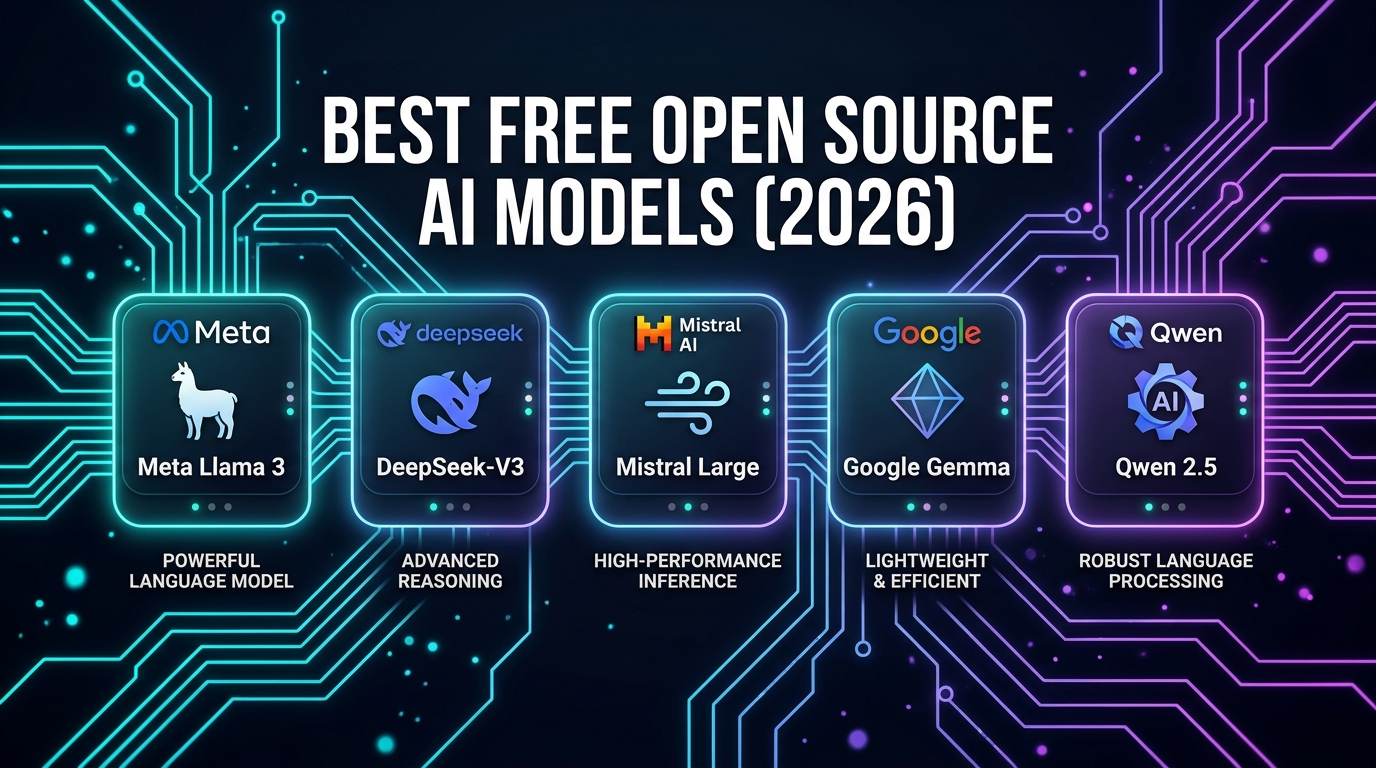
- Best Overall Open Foundation Model: Meta Llama 3.3 (70B) (exceptional general knowledge, multilingual proficiency, and massive tool ecosystem).
- Best for Advanced Reasoning & Math: DeepSeek-V3 / DeepSeek-R1 (groundbreaking mixture-of-experts architecture rivaling closed commercial frontiers).
- Best for Coding & Technical Software Engineering: Qwen 2.5-Coder (32B / 72B) (state-of-the-art Python, TypeScript, and system programming benchmark scores).
- Best Lightweight Model for Consumer Hardware (8GB–16GB VRAM): Google Gemma 2 / Gemma 3 (9B) (dense, distilled precision with minimal memory footprint).
- Best for Multilingual European Compliance & Vision: Mistral Large 2 & Pixtral 12B (strict European data ethics, native 128k context, and multimodal visual reasoning).
Master Comparison Table: Top Open-Weight AI Models (2026)
| Model Name | Developer / Organization | Architecture Type | Parameters | Native Context Window | MMLU-Pro / GSM8K Score | Open License Type | Minimum Recommended VRAM (Quantized) |
|---|---|---|---|---|---|---|---|
| Meta Llama 3.3 | Meta AI | Dense Transformer | 70B | 128,000 tokens | 71.2% / 92.4% | Llama 3.3 Community License | 40GB (Q4: 36GB VRAM) |
| DeepSeek-V3 | DeepSeek AI | Mixture-of-Experts (MoE) | 671B Total (37B Active) | 128,000 tokens | 75.9% / 95.2% | MIT License (Fully Open) | Multi-GPU / Quantized Cluster (48GB+ Q2) |
| Qwen 2.5-Coder | Alibaba Cloud | Dense Transformer | 32B / 72B | 128,000 tokens | 73.8% / 93.1% | Apache 2.0 (Commercial Friendly) | 24GB (32B Q4) / 48GB (72B Q4) |
| Mistral Large 2 | Mistral AI | Dense Transformer | 123B | 128,000 tokens | 74.5% / 91.8% | Mistral Research License / Commercial Tier | 64GB (Q4: 55GB VRAM) |
| Google Gemma 2 | Google DeepMind | Dense Distilled Transformer | 9B / 27B | 8,192 tokens | 64.3% / 88.5% | Gemma Terms of Use | 8GB (9B Q4) / 16GB (27B Q4) |
In-Depth Analysis: The 5 Best Open-Source AI Models
1. Meta Llama 3.3 (70B) — The Industry's Universal Workhorse
Meta's open-weights initiative fundamentally transformed artificial intelligence, and Llama 3.3 (70B) represents the pinnacle of accessible dense model architecture. By leveraging aggressive high-quality data curation and post-training alignment techniques, Llama 3.3 70B matches the capabilities of previous-generation 405B models while requiring a fraction of the compute infrastructure.
Architectural Highlights:
- Extended 128k Token Context Window: Easily handles entire codebases, technical manuals, or lengthy legal contracts in a single prompt.
- Grouped-Query Attention (GQA): Significantly optimizes KV-cache memory consumption during long-context batch generation.
- Ecosystem Dominance: Unrivaled community fine-tunes, LoRA adapters, quantizations (GGUF, AWQ, EXL2), and smooth native integration across Ollama, LM Studio, vLLM, and Hugging Face.
Ideal Workloads:
Production enterprise chatbots, complex automated agent workflows, structured JSON extraction, and on-premises RAG (Retrieval-Augmented Generation) applications.
2. DeepSeek-V3 & DeepSeek-R1 — The Frontier Reasoning Breakthrough
Originating from DeepSeek AI, DeepSeek-V3 and its reasoning-specialized counterpart DeepSeek-R1 sent shockwaves through the AI research sector. Built upon an ultra-efficient Mixture-of-Experts (MoE) foundation, DeepSeek-V3 activates only 37 billion parameters per token out of 671 billion total weights.
Why It Outperforms Competitors:
- Multi-Head Latent Attention (MLA): Compresses the KV cache by over 70%, allowing high-throughput concurrent inference on modest server hardware.
- Chain-of-Thought Reasoning (R1): Matches or surpasses proprietary models like OpenAI o1 on complex mathematical Olympiad problems, PhD-level science queries, and competitive algorithmic programming.
- True Permissive MIT Licensing: Complete freedom for commercial modification, private local deployment, and derivative weight creation without restrictive revenue caps.
Limitations:
Due to its massive 671B total weight footprint, running DeepSeek-V3 unquantized requires enterprise server clusters. However, distilled versions (such as DeepSeek-R1-Distill-Llama-70B or Qwen-32B) offer near-frontier reasoning on single-node hardware.
3. Qwen 2.5-Coder (32B & 72B) — The Definitive Open-Source Coding Engine
Developed by Alibaba Cloud's research team, the Qwen 2.5 family—and specifically Qwen 2.5-Coder—has captured the programming community's admiration. Trained on trillions of code tokens across more than 92 programming languages, it serves as the ultimate open alternative to GitHub Copilot and Claude 3.5 Sonnet.
Standout Capabilities:
- HumanEval Score Exceeding 85%: Demonstrates pinpoint precision on algorithmic challenges, unit test generation, and complex API schema modeling.
- Agentic Function Calling: Natively trained to execute terminal commands, parse syntax trees, and coordinate multi-file refactoring without hallucinating function signatures.
- Permissive Apache 2.0 Licensing: Freely deployable within proprietary commercial SaaS products without legal encumbrance.
4. Google Gemma 2 & Gemma 3 (9B & 27B) — Maximum Performance on Consumer Hardware
Engineered by the research teams at Google DeepMind using the same foundational architectures behind Gemini, Gemma 2 punches far above its parameter weight.
Why It Excels for Local Users:
- Knowledge Distillation Magic: Rather than training from scratch, Google distilled reasoning patterns from massive Gemini frontier teacher models into a compact 9B frame.
- Runs on 8GB GPUs & MacBooks: A 4-bit quantized GGUF of Gemma 2 9B requires less than 6.5 GB of VRAM, running at blisteringly fast speeds (40+ tokens per second) on standard consumer hardware.
- Interleaved Sliding-Window Attention: Ensures lightning-fast inference latency during rapid conversational queries.
5. Mistral Large 2 & Pixtral 12B — European Precision & Multimodal Vision
Paris-based Mistral AI continues to lead open-weight innovation with Mistral Large 2 (123B) and its vision-native sister model Pixtral 12B.
Key Strengths:
- Multilingual Excellence: Exceptional native fluency in French, German, Spanish, Italian, Portuguese, Arabic, and Japanese without translation artifacts.
- Pixtral Multimodal Vision: Inspects high-resolution images, architectural diagrams, PDF charts, and visual tables natively without needing separate optical character recognition (OCR) pre-processors.
- Strict Adherence to System Prompts: Exceptional resistance to prompt injections and jailbreaks, making it ideal for regulated financial and healthcare automation.
How to Run Open-Source AI Models Locally for Free
You do not need an enterprise cloud subscription to deploy these models. Here is the recommended local execution stack:
`
[User Interface] ---> (LM Studio / Open WebUI / Chatbox)
|
[Inference Engine] -> (Ollama / vLLM / llama.cpp)
|
[Hardware Acceleration] -> (Apple Metal / NVIDIA CUDA / AMD ROCm)
`
1. The 2-Minute Ollama Setup
- Download and install Ollama on macOS, Windows, or Linux.
- Open your terminal and run:
```bash
Run Meta Llama 3.3 (70B quantized)
ollama run llama3.3
Run lightweight Google Gemma 2 (9B)
ollama run gemma2:9b
Run world-class coding model Qwen 2.5-Coder (32B)
ollama run qwen2.5-coder:32b
`
- Ollama automatically downloads the quantized GGUF weights, allocates VRAM across your GPU, and hosts a local OpenAI-compatible API endpoint at
http://localhost:11434/v1.
2. LM Studio (For Graphical Desktop Users)
If you prefer a clean GUI comparable to ChatGPT:
- Install LM Studio, browse Hugging Face directly inside the app, select your preferred quantization level (e.g.,
Q4_K_M), and chat locally with zero terminal commands.
Open-Weight vs. Truly Open-Source: Understanding the Licenses
Before integrating open models into commercial products, understand the licensing nuances:
- Permissive Open Source (MIT / Apache 2.0): Used by DeepSeek-V3 (MIT) and Qwen 2.5 (Apache 2.0). Complete freedom for commercial utilization, private hosting, and weight modifications.
- Community Open-Weight Licenses (Meta Llama 3.3): Free for research and commercial use for entities with under 700 million monthly active users. Prohibits using Llama outputs to train competing frontier models without authorization.
- Research-Only vs. Commercial Tiers (Mistral Large 2): Free for non-commercial academic research and offline exploration; commercial enterprise production requires an official commercial agreement or API partnership.
Frequently Asked Questions (FAQ)
Can open-source AI models match GPT-4o and Claude 3.5 Sonnet?
Yes. On standardized academic benchmarks including MMLU-Pro, HumanEval, and GSM8K, frontier open models like DeepSeek-V3, DeepSeek-R1, and Meta Llama 3.3 70B perform within statistical margins of closed commercial APIs. While closed models still hold slight edges on obscure reasoning corner-cases, open models offer complete data privacy and zero API token costs.
What hardware is required to run a 70B parameter model locally?
To run a 70B model with usable throughput, you need approximately 36GB to 40GB of VRAM for a 4-bit (Q4) quantized GGUF. This can be achieved with two Nvidia RTX 3090/4090 GPUs (24GB each) or an Apple Mac with 64GB of Unified Memory (M2/M3/M4 Max). For single 16GB GPUs, dense models up to 14B or 32B run comfortably.
Are open-source AI models private and secure?
When downloaded and run locally via tools like Ollama or llama.cpp, open-source models run 100% offline. No prompt data, user inputs, or generated tokens leave your local physical machine, eliminating compliance risks, data leaks, and third-party model training telemetry.
What is the best free open-source model for coding?
Qwen 2.5-Coder (32B or 72B) is currently recognized as the top open-weight coding model. It exhibits exceptional language syntax accuracy, autonomous file editing, and test generation across dozens of programming languages.
Related AI Resources on AI Launch Watch
- [Autonomous AI Agents & Multi-Agent Frameworks](/categories/ai-agents) — Explore top autonomous systems powered by local LLMs.
- [Best AI Tools for Developers & Coding](/categories/ai-coding) — Discover the latest code editors and autonomous coding assistants.
- [Free AI Research Tools Guide](/ai-news/free-ai-tools-for-research) — Academic literature extraction and research analysis tools.
- [Browse All AI Tools Directory](/ai-tools) — Over 1,000+ verified generative AI tools and applications.