Editorial Transparency & Disclosure:
Target Query: Best AI agents free
Evaluation Framework: Technical analysis of autonomous execution frameworks, open-source repositories, self-hosted deployment models, tool-calling capabilities, and local LLM compatibility.
Last Updated: October 2026 | Author: Alex Vance, Lead AI Editor & Researcher
Related Category: AI Agents
Direct Answer: What Are the Best Free AI Agents?
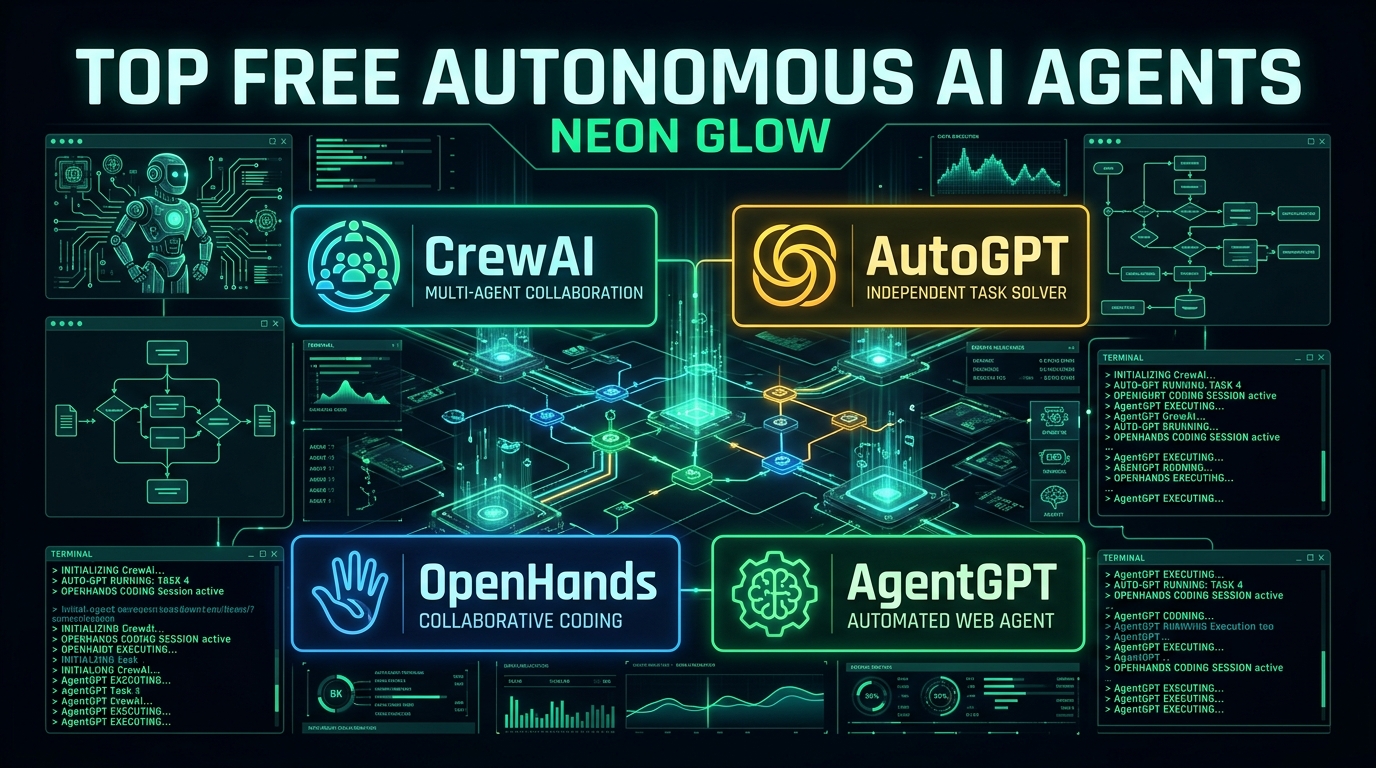
The best free AI agents in 2026 are CrewAI (for orchestrating collaborative multi-agent teams with role-based autonomy), AutoGPT (for open-source, goal-driven recursive task solving and tool use), OpenHands (formerly OpenDevin, for autonomous software engineering and terminal execution), Browser-Use (for autonomous web browsing, DOM navigation, and multi-step browser tasks), and AgentGPT (for zero-setup, browser-based autonomous agent experimentation).
Unlike traditional chatbots that require continuous prompt-and-response turn-taking, autonomous AI agents operate independently: they formulate execution plans, invoke external software tools (browsers, shell terminals, Python interpreters, file systems), evaluate intermediate results, correct their own errors, and run recursively until an overarching objective is achieved.
Below is our technical comparison of the best free autonomous AI agents, their architectural trade-offs, and how to run them with zero API costs using local open-weight models.
Master Comparison: Best Free Autonomous AI Agents in 2026
The following matrix compares the leading free and open-source AI agents across autonomy architecture, deployment requirements, and core competencies:
| Agent / Framework | Architecture Type | Free / Open-Source Tier | Primary Use Case | Local LLM Support (Ollama/vLLM) | Technical Setup |
|---|---|---|---|---|---|
| CrewAI | Role-Based Multi-Agent Team | 100% Open-Source (MIT License) | Collaborative enterprise workflows, automated research & reporting | Full support (Ollama, LM Studio, vLLM) | Python library (pip install crewai) |
| AutoGPT (Forge) | Recursive Goal-Directed Autonomous Agent | 100% Open-Source (MIT License) | Autonomous market research, multi-step web scraping & data synthesis | Supported via LiteLLM / local endpoints | Docker or Python CLI |
| OpenHands | Autonomous Software Engineer | 100% Open-Source (MIT License) | Writing code, running terminal commands, debugging repos & git PRs | Full support (DeepSeek-Coder, Llama-3, Qwen) | Docker container with sandboxed VM |
| Browser-Use | Computer-Vision Web Navigation Agent | 100% Open-Source (MIT License) | Interacting with websites, filling forms, extracting dynamic DOM data | Supported via vision-enabled local models | Python library (pip install browser-use) |
| AgentGPT | Web-Based Recursive Task Agent | Free community tier / Open-source repo | Quick goal prototyping, educational task decomposition | Available in self-hosted Docker edition | Zero setup (Cloud web app) or Docker |
Detailed Reviews: The 5 Best Free AI Agents
1. CrewAI: The Leading Open-Source Multi-Agent Orchestrator
CrewAI has established itself as the industry standard open-source framework for building autonomous multi-agent systems. Rather than relying on a single monolithic model trying to accomplish disparate objectives, CrewAI models human organizational structures by allowing developers to assign specialized Roles, Goals, and Backstories to distinct agents.
How It Works
A typical CrewAI deployment configures a team—for example, a Senior Market Researcher agent paired with a Technical Writer agent and an Executive Editor agent. The researcher agent uses web-scraping tools to gather source material; upon task completion, it delegates its structured output to the writer agent, which drafts an analysis, which is then reviewed and critiqued by the editor agent before final delivery.
Free & Open-Source Availability
- License: 100% Free under the MIT Open-Source License.
- Hosting: Completely self-hostable on your local machine, server, or cloud VM.
- Zero API Cost Option: Native integration with Ollama allows you to run all agents against local open-weight models (such as Llama 3.3, Mistral, or DeepSeek) without paying commercial API tokens.
Key Strengths
- Role-Based Specialization: Prevents model confusion by enforcing strict agent personas and constrained toolsets.
- Human-in-the-Loop Interventions: Allows users to approve critical tool execution steps (such as sending an email or executing a database query) before the agent proceeds.
- Sequential & Hierarchical Processes: Supports linear handoffs as well as manager-led task delegation.
Ideal For
Automated competitive intelligence, automated content pipelines, multi-source financial report compilation, and complex data analysis tasks.
2. AutoGPT: The Classic Recursive Goal-Directed Autonomous Agent
AutoGPT pioneered the autonomous AI agent ecosystem in 2023 and has since matured into an extensible agent development platform through its AutoGPT Forge architecture.
How It Works
You provide AutoGPT with a high-level mission (e.g., "Investigate the top 5 emerging open-source robotic platforms launched in 2026, synthesize their technical specifications, and output a comparison markdown file"). AutoGPT autonomously breaks the mission down into discrete milestones, creates a task queue, browses the web, downloads files, executes Python scripts, monitors its own progress, and reflects on whether it has satisfied the objective.
Free & Open-Source Availability
- License: 100% Free and open source on GitHub.
- Interface: Runs via terminal CLI or local web GUI.
- Community Ecosystem: Thousands of pre-built blocks and community plugins available at zero cost.
Key Strengths
- Self-Directed Recursion: Capable of continuing long-running autonomous execution loops without human prompting.
- Persistent Memory: Utilizes local vector databases (Chroma, FAISS) to maintain state and recall facts discovered in earlier steps.
- Modular Block Builder: The Forge graphical interface allows chaining agent triggers and tools visually.
When to Be Cautious
Unconstrained autonomous loops can burn through commercial API tokens rapidly or enter circular reasoning traps if given ambiguous goals. Always set maximum iteration limits and budget caps.
3. OpenHands (Formerly OpenDevin): Autonomous Software Engineering in Docker
OpenHands is an open-source autonomous coding agent designed to operate like a junior software engineer. It is the leading open-source alternative to proprietary coding agents like Cognition Devin and Cursor Agent.
How It Works
OpenHands runs inside a secure, sandboxed Docker container that mirrors a developer's local environment. It has access to a bash terminal, a code editor, a file explorer, and a web browser. When given an issue—such as "Fix the failing unit tests in our authentication module and submit a git commit"—OpenHands reads the codebase, reproduces the test failure, modifies the source code, re-runs the test suite to verify the fix, and formats a clean pull request.
Free & Open-Source Availability
- License: Free, open-source community platform.
- Self-Hosting: Spins up locally via a single Docker command (
docker run -it -p 3000:3000 ...). - Model Agnostic: Works smoothly with commercial APIs (Anthropic Claude 3.5 Sonnet, OpenAI o1) as well as free local coding models (DeepSeek-Coder V2/V3, Qwen 2.5 Coder) via Ollama.
Key Strengths
- Real Terminal & Sandboxed Execution: Actually runs compilers, linters, package managers (
npm,pip,cargo), and test suites rather than merely guessing code snippets. - Interactive UI: Features a sleek split-screen interface showing the agent's thought process, bash console, code diff, and browser preview side by side.
- Git Native: Directly clones repositories, checks out branches, and commits changes.
Ideal For
Automated bug fixing, library migrations, test suite generation, and software repository maintenance.
4. Browser-Use: Autonomous Web Navigation & DOM Interaction
Browser-Use is a breakout open-source AI agent library designed specifically to enable language models to interact with the modern web exactly like a human user.
How It Works
Browser-Use pairs an LLM with Playwright and computer vision to inspect web pages. Instead of relying on brittle CSS selectors that break whenever a website updates, Browser-Use converts the live browser viewport into an interactive accessibility tree and visual screenshot grid. The agent can click buttons, type into input fields, solve navigation flows, extract tables behind logins, and navigate pagination autonomously.
Free & Open-Source Availability
- License: 100% Open-Source under MIT.
- Installation: Simple Python package (
pip install browser-use playwright). - Headless or Headed: Can run invisibly in background servers or visibly on your desktop screen so you can observe the cursor moving in real time.
Key Strengths
- Resilient to UI Changes: Uses visual and semantic understanding rather than hardcoded XPath selectors.
- Complex Multi-Step Flows: Easily handles multi-page checkout flows, travel booking searches, data entry across enterprise portals, and job application submissions.
- Vision Model Integration: Operates with high accuracy when paired with multimodal models like Gemini 1.5 Flash or Qwen-2.5-VL.
Ideal For
Web scraping dynamic JavaScript applications, automating repetitive web forms, and testing web application user flows.
5. AgentGPT & BabyAGI: Zero-Setup Autonomous Prototyping
For users who want to experiment with autonomous AI agents without installing Python, Docker, or command-line dependencies, AgentGPT provides the fastest on-ramp.
How It Works
AgentGPT runs directly inside any standard web browser. You provide an Agent Name and Goal. The platform instantly spawns a recursive agent loop based on the BabyAGI architecture:
- Task Creation: Breaks the high-level goal into actionable micro-tasks.
- Task Prioritization: Orders tasks by logical dependency.
- Task Execution: Executes each task using an underlying LLM.
- Result Evaluation & Loop: Analyzes the result, generates new follow-up tasks if necessary, and repeats until completion.
Free Tier Allowances
- Cost: Free web tier with standard community access.
- Setup: Zero installation required; runs in Chrome, Safari, or Firefox.
- Self-Hosting Option: The underlying repository is open source on GitHub if you wish to run it locally with your own API keys.
Key Strengths
- Instant Accessibility: Test autonomous agent logic within 30 seconds of landing on the site.
- Visual Task Breakdown: Transparently displays the queue of completed, active, and pending tasks in real time.
- Exportable Results: Allows downloading the final aggregated task outputs as PDF or text files.
When to Move to Other Tools
The free cloud version enforces execution depth limits to preserve server resources. For production-grade multi-hour automation, transition to CrewAI or OpenHands.
How to Run Autonomous AI Agents 100% Free (Zero API Bills)
The biggest barrier to deploying autonomous AI agents is API token consumption: because agents run iterative reasoning and self-correction loops, a single complex task can consume hundreds of thousands of tokens.
To achieve a 100% free autonomous agent stack, deploy your agents locally using Ollama and high-efficiency open-weights models:
`
┌────────────────────────────────────────────────────────┐
│ LOCAL AGENT STACK (100% FREE) │
├─────────────────────────┬──────────────────────────────┤
│ Orchestration Layer │ CrewAI / OpenHands / AutoGPT │
├─────────────────────────┼──────────────────────────────┤
│ Local Model Host │ Ollama / vLLM / LM Studio │
├─────────────────────────┼──────────────────────────────┤
│ Recommended Models │ Qwen 2.5 7B/14B (Tool Use) │
│ │ DeepSeek-Coder (Code Agent) │
│ │ Llama 3.3 70B (Complex RAG) │
├─────────────────────────┼──────────────────────────────┤
│ Execution Environment │ Local Sandboxed Docker VM │
└─────────────────────────┴──────────────────────────────┘
`
- Install Ollama: Download Ollama from official repositories.
- Pull a Tool-Calling Model: Run
ollama pull qwen2.5:14borollama pull deepseek-coder:6.7b. These models feature native function-calling and JSON mode support required by agent frameworks. - Connect CrewAI to Ollama:
```python
from crewai import Agent, Crew, Task
from langchain_community.llms import Ollama
local_llm = Ollama(model="qwen2.5:14b")
researcher = Agent(
role="Tech Analyst",
goal="Uncover top AI trends in 2026",
backstory="You are an expert analyst exploring emerging technologies.",
llm=local_llm,
verbose=True
)
`
Running this stack on a modern laptop (Apple Silicon M-series or an Nvidia RTX 3060+ PC) delivers fast, fully autonomous execution without a single cent in commercial API fees.
Safety, Sandboxing & Loop Prevention
Because autonomous agents can execute shell commands, modify file systems, and navigate the web, production deployments require strict architectural boundaries:
- Always Sandbox in Docker: Never grant an autonomous agent unrestricted access to your host machine's primary operating system. Run coding agents like OpenHands inside isolated Docker containers with non-root privileges.
- Implement Hard Iteration Limits: Always configure
max_iter=15ormax_execution_time=300in your agent parameters to prevent infinite recursion loops if the agent fails to satisfy a completion condition. - Require Confirmation for High-Risk Actions: Use human-in-the-loop triggers for file deletion, email transmission, financial transactions, or database write operations.
- Dedicated Workspace Directories: Restrict file-writing agents to dedicated scratch folders (e.g.,
./workspace/) to prevent accidental overwrites of system files.
Frequently Asked Questions (FAQ)
What is the best completely free AI agent for beginners?
For beginners who do not want to install software or configure API keys, AgentGPT is the easiest web-based entry point. For developers with Python experience, CrewAI is the most intuitive and powerful free open-source framework.
Can free AI agents run without internet access?
Yes. If you deploy an open-source framework like CrewAI or AutoGPT paired with Ollama running an open-weight model (such as Llama 3.3 or Qwen 2.5), the entire agent loop—including reasoning, planning, and task execution—runs 100% locally on your computer with zero internet access required.
What is the difference between an AI chatbot and an AI agent?
An AI chatbot is reactive: it only answers when prompted, generates text based on its static training, and cannot affect the external world. An AI agent is autonomous and proactive: given a high-level goal, it formulates a multi-step plan, uses external tools (browsers, terminals, calculators), analyzes the result of each step, corrects its own errors, and continues executing until the goal is finished.
Which free AI agent is best for coding and software engineering?
OpenHands (formerly OpenDevin) is currently the premier open-source autonomous coding agent. It operates inside a Docker sandbox with an integrated bash terminal, code editor, and git client, allowing it to autonomously read repositories, modify files, run tests, and fix bugs.
How do I prevent autonomous AI agents from spending too much money?
If you are using commercial API keys (OpenAI, Anthropic), set hard monthly spend limits in your provider dashboard and enforce max_iterations (e.g., 10–20 loops) in your agent configuration. Alternatively, eliminate API costs entirely by routing your agents through local models hosted on Ollama.
Editorial Verdict
Autonomous AI agents have transitioned from experimental novelties into viable production frameworks. For multi-step research, business processes, and content pipelines, CrewAI represents the best balance of power, community support, and local model flexibility. For software engineering, OpenHands is the top open-source choice.
To discover upcoming autonomous tools, robot agents, and software launch scorecards, explore the [AI Launch Watch Autonomous Agents Hub](https://ailaunchwatch.com/categories/ai-agents).