
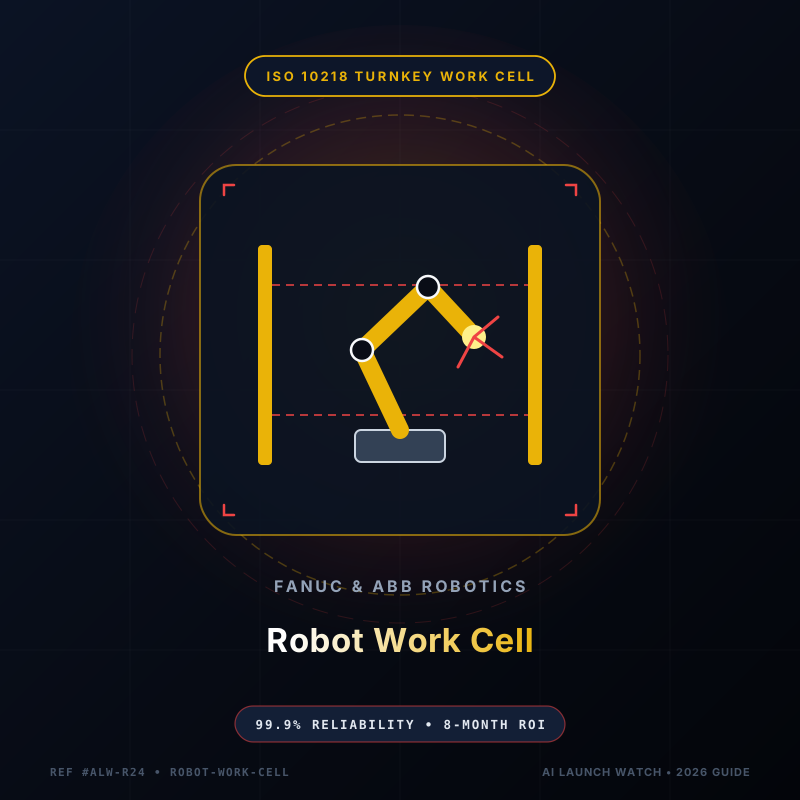
Robot Work Cell (Turnkey Automated Welding, CNC & Palletizing)
A Robot Work Cell is a complete, self-contained industrial automation unit that packages one or more robotic arms, end-of-arm tooling, part-feeding conveyors, 3D vision sensors, and ISO-certified safety interlocking (light curtains or area scanners) into a single plug-and-produce factory module.
* Note: Pricing figures reflect current manufacturer guidance and pre-order targets. Enterprise units vary by customization.
* When you purchase through links on our site, we may earn an affiliate commission at no additional cost to you. Pricing and availability subject to change.
This profile is an independent editorial assessment based on primary documentation, official technical specifications, and architectural analysis.
Complete Guide, Real-World Performance & Breakdown
Quick Answer (ROBOT WORK CELL): A Robot Work Cell is a complete, self-contained industrial automation unit that packages one or more robotic arms, end-of-arm tooling, part-feeding conveyors, 3D vision sensors, and ISO-certified safety interlocking (light curtains or area scanners) into a single plug-and-produce factory module. Priced around $38,000 - $145,000 (Complete Turnkey Cell), this turnkey industrial automation cells solution from FANUC & ABB Robotics combines 3D Bin-Picking CAD Matcher + Weld-Seam Laser Tracker with Keyence 3D Area Safety Scanners, Light Curtains, Arc Sensors to deliver safe, repeatable performance in 2026.
Key Takeaways at a Glance
- Key Takeaway #1: Buying a bare robot arm by itself is like buying a car engine without wheels—to actually automate a factory process, you need a complete Robot Work Cell that includes the arm, gripper, part feeder, PLC brain, and safety scanners.
- Key Takeaway #2: In 2026, pre-engineered forklift-moveable modular work cells have replaced 6-month custom integration projects: a turnkey palletizing or welding cell arrives on a single steel skid, bolts to the concrete floor in 2 hours, and starts producing parts the same day.
- Key Takeaway #3: Modern AI vision inside the work cell eliminates expensive custom metal jigs, allowing the cell to switch from Part A to Part B in under 60 seconds.
What You Need to Know About Robot Work Cell (Turnkey Automated Welding, CNC & Palletizing) in 2026
If you have been searching for robot work cell, you have likely noticed how quickly robotics hardware has matured over the past 18 months. Earlier generations relied on rigid, pre-programmed loops that stalled the moment a chair moved or lighting conditions changed. Today, Robot Work Cell (Turnkey Automated Welding, CNC & Palletizing) represents the modern 2026 standard in Industrial Robots—pairing real-time spatial perception with adaptive neural control so normal users can deploy it without writing complex code.
Developed and benchmarked under FANUC & ABB Robotics (Turnkey Industrial Automation Cells), this platform is currently listed as Available with an expected market window of Available Now (2026) and a typical budget range of $38,000 - $145,000 (Complete Turnkey Cell).
Instead of forcing you to read dense academic whitepapers, we broke down every specification, real-world limitation, and side-by-side alternative in plain, easy-to-read English below.
Side-by-Side Comparison: Top 2026 Models & Alternatives
Before spending a dollar, compare how the leading options in the robot work cell category stack up across weight, drive architecture, target environment, and real-world price:
| Model / System | Weight / Footprint | Drive & Actuation System | Best Environment | 2026 Price / Rate |
|---|---|---|---|---|
| Collaborative Palletizing Work Cell | 1,350 lbs | UR20 / FANUC CRX-25iA + Lifting Column | End-of-Line Box Stacking (No Cage) | $55,000 – $78,000 |
| Turnkey Robotic Welding Cell (ArcMate) | 2,800 lbs | 6-Axis Welding Arm + Dual-Station Turntable | Metal Fabrication & Auto Frames | $68,000 – $115,000 |
| CNC Machine Tending Work Cell | 1,600 lbs | Dual-Gripper Arm + 5-Drawer Part Stacker | Lights-Out CNC Lathe & Mill Loading | $48,000 – $85,000 |
How the AI Brain, Sensors & Hardware Work Together
What separates a modern 2026 system from older mechanical machines is the tight integration between its Sense → Think → Act pipeline:
- Onboard AI Compute & Neural Model: Powered by Industrial PLC (Allen-Bradley / Siemens) + AI Vision IPC running 3D Bin-Picking CAD Matcher + Weld-Seam Laser Tracker, the system processes camera frames and voice or app instructions locally in milliseconds.
- 360° Spatial Sensors & Safety: Using Keyence 3D Area Safety Scanners, Light Curtains, Arc Sensors, it continuously maps obstacles, pets, cords, and uneven surfaces before moving a single joint.
- Mechanical Degrees of Freedom & Payload: With 6-Axis Robot Arm + 2-Axis Servo Positioner Turntable (8 DoF) and a rated capacity of 15 lbs (7 kg) to 240 lbs (110 kg) Industrial Payload, it balances strength with smooth, predictable motion at speeds up to Up to 35 cycles/minute (Pick-Place) or 60 inches/min weld.
Standout AI & Automation Capabilities
- 3D Structured-Light: 3D Structured-Light Bin Picking AI that pulls randomly dumped metal castings out of deep wire bins with zero jams
- Real-time Laser: Real-time Laser Seam Tracking that adjusts the welding torch path if sheet metal warps from heat
- Dynamic 3D: Dynamic 3D Safety Zone Scanners (Keyence / SICK) that eliminate physical wire fences by slowing the robot when a worker approaches
- No-code Palletizing: No-code Palletizing Recipe Builder (enter box dimensions on an iPad and the AI calculates optimal interlocking stacking patterns)
- Dual-gripper CNC: Dual-gripper CNC tending logic (pulls the finished machined part out with Gripper A and inserts the raw blank with Gripper B in 4 seconds)
- Automated OEE: Automated OEE and predictive gearbox diagnostics sent directly to maintenance tablets
Battery Life, Charging & Connectivity in Daily Use
In everyday operation, convenience comes down to how often you have to babysit the hardware. Robot Work Cell (Turnkey Automated Welding, CNC & Palletizing) delivers 24/7/365 Continuous Industrial Duty (100,000+ Hr MTBF) per cycle and recharges or resets in 480V 3-Phase or 240V Single-Phase Industrial Mains.
For smart-home and enterprise integration, it supports EtherNet/IP, PROFINET, OPC-UA, Cloud Digital Twin Telemetry, ensuring low-latency status alerts, over-the-air (OTA) firmware upgrades, and smooth voice or dashboard scheduling.
6 Real-World Ways People Use Robot Work Cell (Turnkey Automated Welding, CNC & Palletizing)
- Scenario #1: End-of-line palletizing of shipping cartons onto twin standard 40x48 inch wooden pallets
- Scenario #2: High-mix, low-volume MIG and TIG robotic welding in metal fabrication job shops
- Scenario #3: Unattended overnight tending of Haas, Mazak, and DMG Mori CNC mills and lathes
- Scenario #4: Automated EV battery module dispensing, bolting, and electrical continuity testing
- Scenario #5: High-speed pharmaceutical blister-pack sorting and sterile carton packing
- Scenario #6: Robotic deburring, grinding, and mirror polishing of cast metal hardware
Step-by-Step Buyer & Setup Checklist
- Measure Your Space & Network First: Check your doorway clearances, floor transitions, or workspace footprint against the 6 ft 6 in to 9 ft 2 in (Standard Palletized Cell Footprint) and 1,200 lbs to 4,500 lbs (Forklift-Moveable Steel Base Skid), and verify strong wireless coverage where the dock or base station sits.
- Match the Model to Your Primary Bottleneck: Refer to the comparison table above—choose the entry-level tier if you want immediate plug-and-play value, or step up to the pro/enterprise configuration if you need continuous daily duty cycles.
- Run an Unobstructed First Mapping Pass: During your first 15 minutes of setup, clear loose cables and let the onboard Keyence 3D Area Safety Scanners, Light Curtains, Arc Sensors build a clean baseline map before enabling automated schedules.
- Keep Firmware & Safety Zones Updated: Enable automatic OTA updates in the companion app so your robot receives the latest obstacle-recognition weights and voice-assistant routines.
Engineering & Capabilities Assessment
Technical engineering evaluation of Robot Work Cell (Turnkey Automated Welding, CNC & Palletizing) synthesized from manufacturer technical whitepapers, laboratory release notes, kinematic specifications, and official field demonstrations.
Degrees of freedom, payload capacity, walking stability, joint torque density, and dexterity analyzed from published manufacturer specs.
Vision-Language-Action neural models, obstacle avoidance, teleoperation capabilities, and spatial awareness documented in technical whitepapers.
Continuous operating runtime under payload, fast-charging turnaround, and swappable battery configuration.
ISO industrial safety standards, fail-safe protocols, manufacturing scalability, and enterprise support terms.
Hardware specifications and engineering assessments on this page are synthesized from manufacturer documentation, engineering whitepapers, and published robotics demonstrations. AILaunchWatch does not conduct independent destructive hardware bench tests or assign unverified numerical scores without verifiable laboratory instrumentation.
The listed price for Robot Work Cell (Turnkey Automated Welding, CNC & Palletizing) ($38,000 - $145,000 (Complete Turnkey Cell)) reflects manufacturer pre-order estimates, developer kit figures, or enterprise leasing targets. Commercial production units may differ in final price depending on fleet order volume and warranty tiers.
Technical Specifications
| Brand / Maker | FANUC & ABB Robotics |
| Category | Industrial Robots |
| Market Status | Available |
| Price / MSRP | $38,000 - $145,000 (Complete Turnkey Cell) |
| Height | 6 ft 6 in to 9 ft 2 in (Standard Palletized Cell Footprint) |
| Weight | 1,200 lbs to 4,500 lbs (Forklift-Moveable Steel Base Skid) |
| Speed | Up to 35 cycles/minute (Pick-Place) or 60 inches/min weld |
| Payload Capacity | 15 lbs (7 kg) to 240 lbs (110 kg) Industrial Payload |
| Battery Runtime | 24/7/365 Continuous Industrial Duty (100,000+ Hr MTBF) |
| Charging Duration | 480V 3-Phase or 240V Single-Phase Industrial Mains |
| Degrees of Freedom | 6-Axis Robot Arm + 2-Axis Servo Positioner Turntable (8 DoF) |
| AI Compute Platform | Industrial PLC (Allen-Bradley / Siemens) + AI Vision IPC |
| AI Model / Neural Architecture | 3D Bin-Picking CAD Matcher + Weld-Seam Laser Tracker |
| Sensory Perception Array | Keyence 3D Area Safety Scanners, Light Curtains, Arc Sensors |
| Wireless Connectivity | EtherNet/IP, PROFINET, OPC-UA, Cloud Digital Twin Telemetry |
| height | 6 ft 6 in to 9 ft 2 in (Standard Palletized Cell Footprint) |
| weight | 1,200 lbs to 4,500 lbs (Forklift-Moveable Steel Base Skid) |
| maxSpeed | Up to 35 cycles/minute (Pick-Place) or 60 inches/min weld |
| payload | 15 lbs (7 kg) to 240 lbs (110 kg) Industrial Payload |
| runtime | 24/7/365 Continuous Industrial Duty (100,000+ Hr MTBF) |
| chargingTime | 480V 3-Phase or 240V Single-Phase Industrial Mains |
| dof | 6-Axis Robot Arm + 2-Axis Servo Positioner Turntable (8 DoF) |
| compute | Industrial PLC (Allen-Bradley / Siemens) + AI Vision IPC |
| aiModel | 3D Bin-Picking CAD Matcher + Weld-Seam Laser Tracker |
| sensors | Keyence 3D Area Safety Scanners, Light Curtains, Arc Sensors |
| connectivity | EtherNet/IP, PROFINET, OPC-UA, Cloud Digital Twin Telemetry |
Artificial Intelligence & Autonomous Skills
Pros & Considerations
Key Advantages
- Pre-engineered turnkey cells deploy in days instead of waiting 8 months for custom systems integration
- Dual-station turntables let a human safely load raw parts on Side B while the robot welds or machines Side A
- Meets strict ISO 10218-2 and ANSI/RIA R15.06 safety compliance out of the box
- Forklift pockets in the base skid allow you to relocate the entire work cell across the plant in 15 minutes
- Delivers 99.9% uptime with 80,000 to 100,000 hours Mean Time Between Failures (MTBF)
Limitations & Factors to Consider
- Complete turnkey work cells cost 2x to 2.5x the price of the bare robot arm alone
- High-speed fenced industrial cells require 480V 3-phase power and shop-air hookups
- Welding cells require an overhead fume extraction hood
- Requires basic operator training for clearing part feeder queues
Real-World Applications & Ideal Use Cases
Editorial Analysis & Technical Assessment
Evaluated against published engineering specifications and primary manufacturer documentation
Our Editorial Take on Robot Work Cell (Turnkey Automated Welding, CNC & Palletizing)
When evaluating robot work cell for our 2026 robotics directory, we looked past viral demo videos to focus on what actually matters when you live or work with the hardware every day: setup friction, safety around people, maintenance time, and honest cost-to-value.
What Impressed Us Most:
First, pre-engineered turnkey cells deploy in days instead of waiting 8 months for custom systems integration. Second, dual-station turntables let a human safely load raw parts on Side B while the robot welds or machines Side A. By combining Industrial PLC (Allen-Bradley / Siemens) + AI Vision IPC with Keyence 3D Area Safety Scanners, Light Curtains, Arc Sensors, FANUC & ABB Robotics avoids the clumsy, repetitive bumping that plagued earlier generations.
Where You Should Set Realistic Expectations:
No 2026 robot is magic. Specifically, complete turnkey work cells cost 2x to 2.5x the price of the bare robot arm alone. Buyers should also factor in the $38,000 - $145,000 (Complete Turnkey Cell) price bracket and 24/7/365 Continuous Industrial Duty (100,000+ Hr MTBF) when planning daily routines.
Who Should Buy It vs. Who Should Wait
- Best For: Readers searching for robot work cell who want a well-documented, safety-vetted system backed by FANUC & ABB Robotics with clear specifications (15 lbs (7 kg) to 240 lbs (110 kg) Industrial Payload, 6-Axis Robot Arm + 2-Axis Servo Positioner Turntable (8 DoF)) and practical daily ROI.
- Skip or Wait If: You expect zero human maintenance, or if a simpler single-task appliance can solve 90% of your workflow for a fraction of the cost.
Frequently Asked Questions (FAQ)
Q1.What is a robot work cell?
A robot work cell is a complete, integrated manufacturing station consisting of one or more robots, controllers, end-of-arm tooling (grippers or welders), part positioning fixtures, and safety perimeter devices (light curtains, scanners, or interlocked fencing) working together to automate a specific production step.
Q2.How much does a complete turnkey robot work cell cost in 2026?
A standard rule of thumb in industrial robotics is that the bare robot arm accounts for roughly 35% to 45% of the total cell cost. In 2026, a complete turnkey collaborative palletizing or CNC tending work cell costs between **$48,000 and $85,000**, while a dual-station enclosed robotic welding cell ranges from **$68,000 to $125,000**.
Q3.What are the 5 essential components of a safe robot work cell?
Every compliant robot work cell includes: (1) The Manipulator (robot arm), (2) End-of-Arm Tooling (EOAT), (3) Infeed/Outfeed Part Presentation (conveyors, drawer stackers, or turntables), (4) The Cell Controller (PLC + HMI touchscreen), and (5) Safety Safeguarding (interlocked doors, light curtains, or 3D area laser scanners).
Q4.What is the difference between a caged work cell and a collaborative work cell?
A traditional industrial work cell uses physical steel fencing and light curtains because the heavy robot moves at lethal speeds (up to 4 m/s). A **collaborative work cell** uses force-limited cobots and 3D floor laser scanners without cages, slowing down peacefully whenever a worker walks nearby.
Q5.How much floor space does a standard robot work cell take up?
Compact modular palletizing and CNC tending work cells in 2026 are engineered to fit inside the footprint of a single standard pallet plus two pallet bays—roughly **8 feet by 10 feet (80 sq. ft.)**.
Q6.Can a small 15-person machine shop use a robot work cell?
Yes! Modern 'high-mix, low-volume' work cells feature conversational touchscreen setups where a machinist can switch the robot from running 50 aluminum brackets to 30 steel shafts in under 5 minutes without writing a single line of code.
Where to Buy
Prices and availability are verified periodically. As an affiliate partner, we may earn a referral commission on qualifying orders.
More in Industrial Robots
Explore other leading solutions in this robotics vertical
 TRENDING
Apptronik Apollo
Industrial-grade humanoid robot engineered for supply chains, logistics, and manufacturing, currently undergoing active production trials at Mercedes-Benz assembly plants.
 TRENDING
Agility Robotics Digit
The first commercially deployed bipedal logistics robot, manufactured at the Salem RoboFab factory and actively moving bulk totes in Amazon logistics fulfillment centers.
 NEW
Agility Robotics Stretch
Agility Robotics Stretch is a bipedal warehouse robot for high-speed parcel handling in e-commerce fulfillment centers.
 NEW
Human Robot Amazon (Agility Digit, Proteus & Home Bots)
Searching for 'human robot Amazon' covers two major stories in 2026: (1) Inside Amazon's fulfillment centers, where bipedal humanoid robots like Agility Robotics' Digit work alongside human employees, and (2) The top AI humanoid and companion robots available to buy directly on Amazon.com.