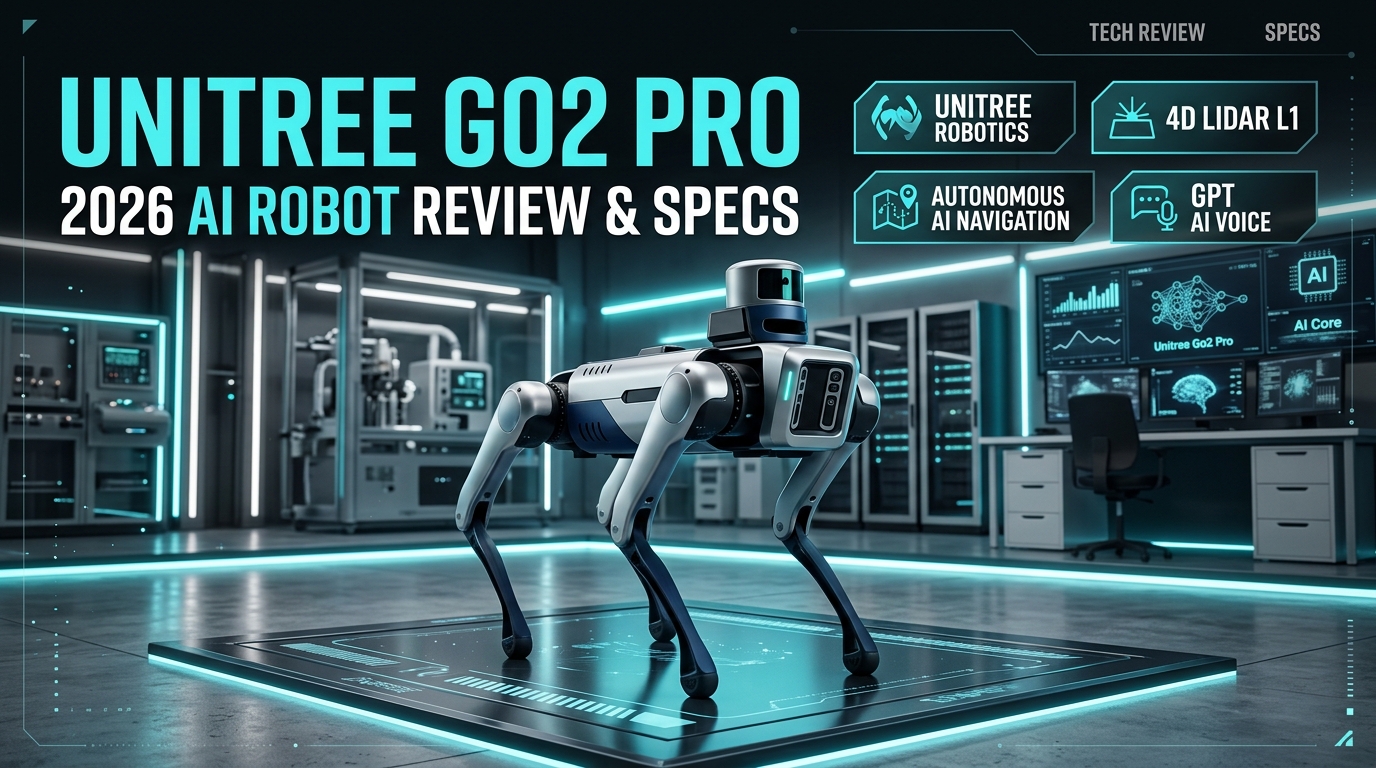
The quadruped robotics market experienced a dramatic shift when Unitree Robotics released the Go2 series. Traditionally, high-mobility four-legged robotic platforms—most famously represented by the industrial-grade Boston Dynamics Spot—demanded corporate enterprise budgets ranging between $75,000 and $100,000. The [Unitree Go2 Pro](/robots/unitree-go2-pro) disrupts this status quo by delivering ultra-wide 4D hemispherical LiDAR, multimodal large language model voice integration, and dynamic stair-climbing locomotion at a commercial starting price of approximately $2,800 to $3,050 USD.
Whether you are a robotics researcher evaluating autonomous sensor payloads, an enterprise facility manager inspecting remote infrastructure, or an advanced tech enthusiast seeking an embodied AI platform, this detailed breakdown delivers verified hardware specifications, locomotion benchmark data, model tier comparisons, and practical deployment considerations.
What Is the Unitree Go2 Pro?
The Unitree Go2 Pro is an intelligent bionic quadruped robot engineered for consumer, research, and light industrial deployment. Weighing approximately 15 kilograms (33 lbs) with battery installed, it combines high-torque knee-joint actuators with onboard spatial computing and Unitree's proprietary ultra-wide 4D LiDAR L1 sensor.
Unlike entry-level hobbyist toys or static wheeled telepresence devices, the Go2 Pro utilizes sophisticated dynamic balance control algorithms. It can self-right after tripping, ascend standard architectural staircases, navigate dense gravel or wet turf, and sprint at speeds approaching 5 meters per second (approx. 11 mph).
Key Architectural Highlights:
- Unitree 4D LiDAR L1 Sensory Dome: Provides an unprecedented $360^\circ \times 90^\circ$ hemispherical perception field with a 0.05-meter blind spot.
- Multimodal GPT AI Voice Interaction: Native integration of conversational speech processing that parses spoken human commands into motion primitives and locomotion paths.
- Intelligent Side-Follow System (ISS 2.0): Optical and wireless positioning that allows the robot to walk companionably beside an operator rather than lagging behind.
- High-Output Actuator Joints: 12 internal brushless motors producing 45 N·m of peak joint torque, cooled by internal thermal management channels.
- Integrated Wireless Connectivity: 4G cellular LTE modem slot, dual-band Wi-Fi 6, and Bluetooth 5.2 for real-time remote telemetry and video streaming.
Unitree Go2 Model Tier Comparison: Air vs. Pro vs. Edu
Unitree manufactures the Go2 platform across three distinct production tiers. Selecting the appropriate model depends heavily on whether your workflow requires onboard high-level compute, 4G cloud teleoperation, or low-level ROS2 motor control.
| Specification / Feature | Unitree Go2 Air | Unitree Go2 Pro | Unitree Go2 Edu |
|---|---|---|---|
| Target Audience | Enthusiasts, Hobbyists | Creators, Prosumers, Field Techs | Academic Labs, Enterprise R&D |
| Approximate Base Price | ~$1,600 USD | ~$2,800 – $3,050 USD | ~$8,000 – $13,000+ USD |
| 4D LiDAR L1 | Standard (Included) | Standard (Included) | Standard (Included) |
| Maximum Running Speed | 2.5 m/s (~5.6 mph) | Up to 5.0 m/s (~11.2 mph) | Up to 5.0 m/s (~11.2 mph) |
| Peak Joint Torque | ~35.5 N·m | ~45.0 N·m | ~45.0 N·m (Industrial Grade) |
| Secondary High-Level Compute | None (Basic MCU) | Octa-Core High-Compute SoC | NVIDIA Jetson Orin (Up to 100 TOPS) |
| 4G Cellular Module | Not Supported | Pre-installed eSIM / SIM slot | Pre-installed 4G / 5G Option |
| Wireless Follow-Me (ISS 2.0) | UWB Remote Only | Advanced UWB + Vision Tracking | Multi-Tag UWB + RTK Precision |
| Secondary Development API | Limited High-Level API | Extended Python / App API | Full ROS / ROS2, C++, Low-Level Motor DDS |
| Warranty & Support | Standard 1-Year Consumer | Priority Support | Enterprise Dedicated Engineering |
For most professional developers and commercial operators, the Go2 Pro represents the price-to-performance sweet spot: it delivers nearly double the peak speed and torque of the Air edition, includes pre-configured 4G long-range connectivity, and enables the high-level computational core necessary for autonomous waypoint cruising.
Hardware Architecture & Technical Specifications
To understand how the Unitree Go2 Pro achieves stability across unpredictable terrain, examine the verified engineering parameters below:
1. Actuator Mechanics & Kinematics
The Go2 Pro features 12 degrees of freedom (DOF)—three actuators per leg governing hip roll, hip pitch, and knee flexion. The newly engineered knee motor joints feature heat-dissipating aluminum alloy casings with integrated absolute encoders.
During aggressive sprint maneuvers, each joint generates up to 45 N·m of peak torque, allowing the unit to execute vertical leaps up to 0.7 meters, dynamic front flips (in controlled software modes), and rapid posture shifts to absorb unexpected impact strikes.
2. 4D LiDAR L1 Sensor Integration
Traditional 2D LiDAR systems spin in a single planar slice, leaving significant vertical blind zones that fail to detect low ground hazards, curbs, or overhead branches.
The Go2 Pro incorporates Unitree's proprietary 4D LiDAR L1, an ultra-compact sensor mounted centrally on the robot's dorsal crest. It achieves a hemispherical $360^\circ \times 90^\circ$ scan envelope, refreshing real-time 3D point clouds at high frame rates. This enables the obstacle avoidance engine to detect obstacles as close as 5 centimeters (2 inches) away from the chassis.
`
[ 4D LiDAR L1 Dome: 360° x 90° ]
|
+-------------+-------------+
| |
[HD Optical Camera] [Octa-Core AI Engine]
| |
[Ultra-Wide Flashlight] [ISS 2.0 UWB Module]
+-------------+-------------+
|
[12x High-Torque Actuators]
`
3. Battery System & Endurance Metrics
The Go2 Pro is powered by an 8,000 mAh (168 Wh) lithium-ion battery pack equipped with an intelligent Battery Management System (BMS). An optional extended battery (15,000 mAh) is available for prolonged industrial operations.
- Standard 8,000 mAh Battery: Delivers approximately 1.5 to 2.0 hours of continuous mixed locomotion (walking, standing observation, and terrain traversal).
- Heavy Load / High Speed Sprinting: Reduces battery endurance to approximately 50 to 65 minutes.
- Charging Time: Approximately 100 minutes from 10% to 100% using the included 33.6V / 9A rapid wall charger.
Onboard Intelligence: GPT Voice, Navigation & Computer Vision
Beyond physical locomotion, the Unitree Go2 Pro stands apart from predecessor platforms like the Go1 through its modern AI software stack.
Multimodal Conversational AI (GPT Engine)
Integrated directly into the Unitree smartphone application and onboard audio stack, the Go2 Pro leverages an embedded large language model gateway. Operators can communicate with the robot conversationally through its dual noise-canceling microphone array.
Instead of requiring strict predefined voice syntax like "Go forward 3 meters", the robot interprets contextual intent. For example, commanding "Come take a look at this crack on the wall and stay next to me" prompts the robot to activate its ISS 2.0 side-following algorithm, navigate to the operator's spatial coordinate, and tilt its optical camera upward to stream HD footage.
Optical Vision & Lighting
Mounted beneath the nose cone is an ultra-wide 1080p high-definition camera paired with an automated high-lumen LED spotlight. In low-light environments—such as basement inspections, crawl spaces, or nighttime security patrols—the spotlight activates dynamically to maintain visual feature tracking and prevent SLAM (Simultaneous Localization and Mapping) drift.
Verified Field Capabilities vs. Operational Limitations
In real-world deployment across urban, industrial, and outdoor environments, the Unitree Go2 Pro demonstrates decisive strengths along with specific operational constraints:
Proven Strengths:
- Staircase Navigation: Ascends and descends standard indoor and outdoor concrete stairs (riser heights up to 18 cm) with remarkable rhythmic stability.
- Aggressive Terrain Recovery: When pushed or kicked laterally on slick surfaces, the reactive MPC (Model Predictive Control) gait controller dynamically widens foot stance within 80 milliseconds to prevent rollover.
- Remote 4G Teleoperation: With an active SIM card installed, an operator can pilot the robot from across the world via mobile data with sub-150ms video latency.
- Compact Transportability: At 70 cm length and 31 cm width, the unit easily fits inside a standard car trunk or protective pelican case without requiring disassembly.
Critical Limitations to Understand:
- Payload Limitations: Maximum recommended continuous payload is 5 kg (11 lbs) when walking, and up to 8 kg when standing stationary. Mounting heavy dual-sensor gimbals or heavy compute boxes will significantly degrade motor thermal limits and battery life.
- Water Ingress Protection (IP Rating): The Go2 Pro carries an approximate IP54 weather resistance rating. While it withstands light drizzle and damp grass, it is not waterproof. Submerging feet in standing water deeper than 5 cm risks ingress into joint seal bearings.
- Acoustic Noise: While quieter than hydraulic quadrupeds, the high-speed brushless gearboxes and internal cooling fans produce an audible 65–72 dB whine during fast runs, making covert operations impractical.
Comparison: Unitree Go2 Pro vs. Boston Dynamics Spot
For engineers evaluating robotic quadruped procurement, comparing the Go2 Pro to industry standard platforms clarifies the price-to-utility ratio:
| Evaluation Vector | Unitree Go2 Pro | Boston Dynamics Spot |
|---|---|---|
| Acquisition Cost | ~$2,800 – $3,050 USD | ~$75,000 – $100,000+ USD |
| Total Weight | ~15 kg (33 lbs) | ~32.7 kg (72 lbs) |
| Max Payload | 5 kg (Continuous) | 14 kg (31 lbs Continuous) |
| Environmental Rating | IP54 (Splash resistant) | IP54 / IP55 certified |
| Perception Sensor | 4D Ultra-wide LiDAR L1 | 5x Stereo Optical Cameras (LiDAR optional add-on) |
| Operating Time | 1.5 – 2.0 Hours | 90 Minutes (Hot-swappable) |
| Best Use Case | Research, Education, Light Patrol, Creators | Heavy Industrial Inspection, Oil & Gas, Hazmat |
For a complete deep-dive between robotic dogs, explore our Best Robot Dogs in 2026: Spot vs Go2 Pro head-to-head analysis.
Frequently Asked Questions (FAQ)
How much does the Unitree Go2 Pro cost in 2026?
The Unitree Go2 Pro retails for approximately $2,800 to $3,050 USD through official distributors, excluding international shipping tariffs and regional import taxes. The entry-level Go2 Air starts at approximately $1,600 USD, while the enterprise Go2 Edu ranges from $8,000 to over $13,000 depending on computing modules.
Can the Unitree Go2 Pro walk up and down stairs automatically?
Yes. Thanks to its 4D LiDAR L1 real-time terrain point cloud and adaptive footstep height planning, the Go2 Pro routinely climbs and descends standard architectural steps without manual foot placement adjustment.
How long does the battery last on a single charge?
Under typical mixed operation (walking on pavement, pausing to inspect surroundings, and streaming camera feeds), the standard 8,000 mAh battery provides approximately 90 to 120 minutes of run time. Heavy continuous sprinting reduces runtime to under 60 minutes.
Does the Unitree Go2 Pro support ROS2 and custom software development?
The Go2 Pro provides high-level Python and mobile SDK access for telemetry, waypoint planning, and camera feeds. However, if your research demands low-level DDS motor torque control, raw joint angle feeds, or native ROS2 integration, the Unitree Go2 Edu edition is required.
Is the Unitree Go2 Pro safe around children and pets?
While the robot features responsive obstacle avoidance and soft rubber footpads, its high-torque motors produce up to 45 N·m of force. It should always be operated in open environments with responsible human supervision, keeping small children and domestic pets outside its immediate kicking perimeter.
Related Robotics Resources on AI Launch Watch
- [Unitree Go2 Pro Full Database Profile](/robots/unitree-go2-pro) — Detailed specs, live pricing, and verified feature breakdown.
- [Tesla Optimus vs Unitree G1 Humanoid Comparison](/ai-news/tesla-optimus-gen-3-vs-unitree-g1-robot-comparison) — Inspecting the frontier of affordable bipedal robotics.
- [Autonomous AI Agents & Systems Directory](/categories/ai-agents) — Track autonomous navigation and robotics software releases.
- [Explore All Verified AI Robots](/robots) — Compare 30+ humanoid, quadruped, and domestic autonomous robots.